
BigClash Withdrawals Australia: Limits, Timing and Verification
 Available in AU
BigClash withdrawals for Australia
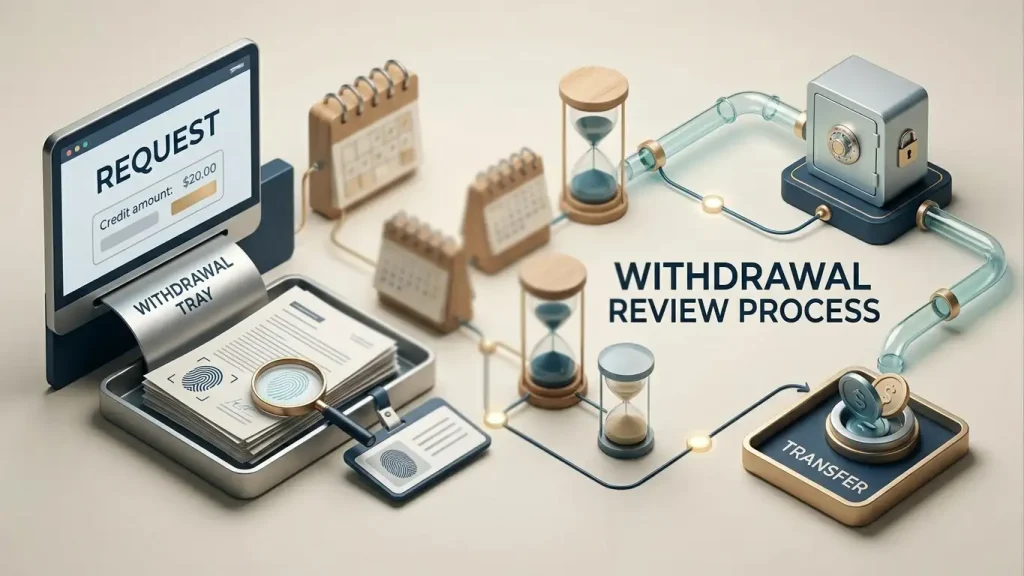
BigClash’s current terms, version 1.12 dated 19 August 2026, list Level 1 AUD withdrawal limits of A$800 per day and A$10,500 per month. The same terms say withdrawal requests are worked through by the financial department within three business days when the relevant conditions are met and checks are complete. That is a processing window, not a guarantee that money will reach an Australian bank, wallet or other payment route within three business days. BigClash may also perform identity, account and source-of-funds checks before completing a withdrawal, so verification can become part of the timing.
Table of Contents
- The current AUD withdrawal limits
- Daily and monthly limits work together
- Three business days is a processing window, not an arrival promise
- Verification can change the withdrawal timeline
- Payment route can affect what happens after approval
- How to read complaints about withdrawals
- Australian tax context is separate from the withdrawal process
- A withdrawal-readiness checklist
- What Australians should check before a BigClash withdrawal
The current AUD withdrawal limits
For an Australian account, the most decision-relevant number is the Level 1 limit because BigClash’s terms make withdrawal ceilings dependent on account level. The official table currently shows A$800 per day and A$10,500 per month at Level 1. Higher account levels have higher limits, but this page does not treat those figures as a promise that every user will qualify for a higher tier or maintain it. BigClash states that account level depends on recent activity and can change.
| Rule | Current Level 1 AUD figure | Practical meaning |
|---|---|---|
| Daily withdrawal limit | A$800 | A request strategy must stay within the daily ceiling unless the account is on a higher level |
| Monthly withdrawal limit | A$10,500 | The monthly cap can matter even when individual daily requests are within A$800 |
| Financial-department processing | Within 3 business days when conditions and checks are complete | This describes internal handling, not final arrival at the payment provider |
The numbers are easy to misread if they are considered in isolation. An A$800 daily maximum does not imply that a user can necessarily withdraw A$800 every calendar day until the monthly limit is reached. Pending requests, account-level rules, verification and payment-system constraints can all affect what can actually be submitted and processed. The terms also allow a maximum of three pending withdrawals, which reinforces the need to think in terms of a queue rather than an unlimited stream of requests.
Daily and monthly limits work together
A practical way to read the Level 1 framework is to treat A$800 as the short-term ceiling and A$10,500 as the longer monthly ceiling. If a user were able to withdraw A$800 on ten separate eligible days, that would total A$8,000 and remain below the monthly cap. Thirteen A$800 withdrawals would total A$10,400, still just below the monthly limit, while a fourteenth full A$800 withdrawal would push the total above it. This example is arithmetic, not a promise that BigClash will process one full withdrawal on each of those days.
The monthly limit therefore becomes especially important for larger balances. A user focusing only on the daily cap could wrongly assume that a large balance can be extracted at a steady A$800 per day without any other ceiling. The official table shows that the account’s monthly level matters as well. Users with a large balance should review the current table before planning a sequence of requests, because exact withdrawal limits are high-risk terms that can change.
For general deposit and cashier context, including why method availability can differ by account, see the main payments page. This withdrawal page focuses on what happens after funds are already in the account.
Three business days is a processing window, not an arrival promise
BigClash’s terms say the financial department works through withdrawal requests within three business days after the request is made, or after the last withdrawal request was paid out, provided the relevant conditions are met and checks are complete. That wording matters. It describes the operator’s internal handling stage. It does not guarantee that the final payment rail will credit an Australian bank account, e-wallet or other destination within the same period.
Once the operator has worked through the request, the receiving payment system can add its own timing. Weekends, banking cut-offs, payment-provider processing and the route used for the payout can all create a gap between “processed by the casino” and “available to spend.” BigClash also states that it may use a different payment system from the one requested, so a user’s preferred route cannot be assumed in every case.
The safe interpretation is therefore narrow: three business days is the current stated internal processing window when conditions are satisfied. It should not be rewritten as “BigClash withdrawals arrive in three days” or used as a guaranteed payout-speed claim.
Verification can change the withdrawal timeline
BigClash’s current terms allow identity, age, residence and source-of-funds checks both before and after deposits and when a withdrawal is being made. The operator can also delay a withdrawal while it checks identity, account balance, source of funds or compliance with the terms. This is why two users making similar withdrawal requests can experience different timelines even when they choose the same nominal payment route.
For Australian users, the practical lesson is to treat KYC as part of withdrawal readiness rather than something that starts only after a problem occurs. Account details should match the user’s real identity, the payment method should belong to the account holder, and records of deposits and ownership of the payment method should be kept. The exact verification process deserves its own treatment, so the detailed document and process discussion sits on the KYC and verification page.
Verification is also one reason why an isolated image of a “pending” withdrawal do not by themselves prove slow or unfair processing. A pending state can reflect ordinary queue handling, an unresolved check, a payment-system delay or a dispute. Without the surrounding account facts, the status alone is not enough to identify the cause.
Payment route can affect what happens after approval
BigClash’s terms say withdrawals are generally handled through payment systems available on the site and that the preferred method cannot always be guaranteed. That creates an important distinction between approval and settlement. A withdrawal can be approved internally but still depend on a card processor, wallet, banking route or another payment service before the money becomes available to the user.
This also means deposit convenience should not be used as a proxy for withdrawal convenience. A method that accepts a deposit quickly may have different payout capabilities, or BigClash may need to use an alternative route. Before depositing significant funds, users should open the cashier and look for withdrawal availability, not just the deposit button. That single check can reveal whether the payment method is genuinely two-way.
If a preferred payout route matters, keep evidence of the current cashier options and review the terms immediately before requesting a withdrawal. Payment menus and provider rules can change more quickly than editorial pages.
How to read complaints about withdrawals
Withdrawal complaints can be useful as signals, but they are not a substitute for the official terms or the facts of a specific account. A complaint may describe a genuine service problem, but it may also omit information about verification, bonus conditions, payment ownership, pending requests or a breached account rule. That is why individual reports should not be turned into a universal statement such as “BigClash always delays withdrawals” or “BigClash never pays.”
A stronger method is to compare complaint themes with the written rules. If many reports mention verification delays, check whether the terms actually allow verification before payment. If reports mention payout caps, compare them with the current AUD limit table. If reports mention long settlement times, separate the operator’s processing stage from the external payment-provider stage. The dedicated complaint signals page deals with how to weigh that type of evidence without treating anecdotes as verified universal behaviour.
Australian tax context is separate from the withdrawal process
A casino withdrawal is a movement of money out of the account; it is not itself a tax ruling. The Australian Taxation Office states that betting and gambling wins are generally not assessable for ordinary recreational gambling, unless the person is carrying on a betting or gambling business. Whether gambling activity amounts to a business depends on the facts and circumstances.
That tax context should not be confused with BigClash’s own account rules. The casino can still require verification and apply withdrawal limits regardless of whether a recreational win is generally non-assessable for Australian income-tax purposes. Users whose activity could amount to a business, or whose tax position is unusual, should rely on current ATO guidance or professional advice rather than assuming the ordinary recreational treatment applies automatically.
A withdrawal-readiness checklist
- Check the current AUD withdrawal-limit table before submitting a request.
- Confirm the account’s current level rather than assuming Level 1 or a higher tier.
- Separate BigClash’s internal processing window from the final payment-provider arrival time.
- Make sure account identity and payment-method ownership details are accurate and current.
- Keep documents and transaction records available in case KYC or source-of-funds checks are requested.
- Check how many withdrawals are already pending before submitting another request.
- Do not treat a deposit method as guaranteed to be the final payout route.
This checklist addresses the points most likely to create avoidable friction. It does not guarantee a payout date, because the current terms explicitly make processing conditional on checks and allow variation in payment routing.
For the broader context, see the BigClash Australia review.
What Australians should check before a BigClash withdrawal
The current official terms give Australian users concrete numbers to work with: Level 1 is listed at A$800 per day and A$10,500 per month, while the financial department’s stated processing window is within three business days when the relevant conditions and checks are complete. Those figures are useful only when read alongside the verification and payment-routing rules. Before requesting a withdrawal, confirm the current account level, make sure identity and payment ownership information can be verified, and distinguish internal processing from final settlement. That is the most reliable way to interpret BigClash withdrawal timing without turning a conditional rule into a guarantee.